
You’re staring at a wall of knobs, patch cables, and glowing LEDs, wondering if you’ll ever make a sound that doesn’t resemble a dying robot. That’s the moment you need a reliable analog synth or MIDI controller that feels intuitive and sounds incredible. This Arturia analog lab review is your guide to the best Arturia gear in 2026, whether you’re a bedroom producer, a live performer, or a sound designer chasing that perfect analog warmth.
We’ve evaluated nine standout Arturia products, from the flagship PolyBrute to the compact MicroBrute, to help you choose the right instrument for your workflow. Let’s dive into the details and find your next sonic partner.




Buying Guide: What to Consider in an Arturia Synth or MIDI Keyboard
Polyphony: How Many Voices Do You Need?
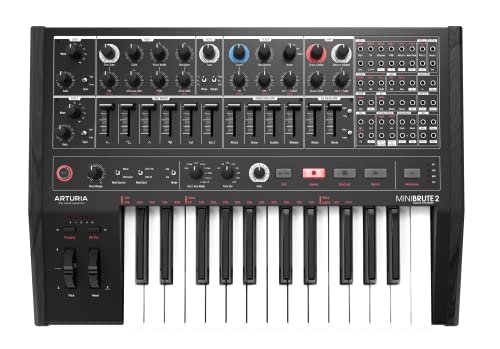
Polyphony determines how many notes you can play simultaneously. If you’re crafting lush pads or complex chord progressions, you’ll want at least six voices, like the Arturia PolyBrute 6-Voice Polyphonic Morphing. For bass lines and leads, a monophonic synth like the Arturia MiniBrute 2 Semi-Modular Analog can be more than enough.
Think about your musical style: do you need to play full chords with sustain, or are you focused on single-note melodies? The answer will guide your choice. For a deeper dive into MIDI keyboards with various polyphony options, check out our guide to the best budget full-size MIDI keyboard.
Modulation and Patching: The Heart of Analog Sound
Analog synths shine when you can route modulation creatively. The MatrixBrute Noir 49-key Black Edition offers a massive 12×32 modulation matrix, while the MiniBrute 2S Semi-Modular Analog provides a 48-point patchbay. If you love experimenting with patch cables, these are your playgrounds.
For those who prefer preset-based workflows, the Arturia Analog Experience (Laboratory 61) bundles software with 3500 sounds, but it lacks the hands-on patching of its hardware siblings. Consider how much time you want to spend tweaking versus playing.
Keyboard Feel and Expressiveness
The keyboard action and aftertouch can make or break your performance. The PolyBrute 12 Polyphonic 12-voice Morphing features polyphonic aftertouch, allowing each key to respond independently to pressure. The MiniBrute 2 Semi-Modular Analog has a 25-key keyboard with aftertouch, ideal for expressive solos.
If you’re used to a piano feel, look for a synth with a larger keybed, like the 61-key models from Arturia. For a comparison of controller options, our article on the best MIDI controller for hardware synths is a great resource.
Sequencer and Integration
Many Arturia synths include built-in sequencers for creating patterns without a computer. The MiniBrute 2S Semi-Modular Analog has a 64-step sequencer with velocity-sensitive pads, while the PolyBrute 6-Voice Polyphonic Morphing offers a 64-step polyphonic sequencer. If you plan to integrate with a DAW, USB and MIDI connectivity are essential.
Consider how the synth fits into your existing setup. For example, the Arturia MicroBrute UFO Analog Synthesizer has USB, MIDI, and CV/Gate connections, making it a versatile hub. For more on integrating controllers, see our guide to the best MIDI controller for Koala Sampler.
Final Thoughts
Choosing the right Arturia instrument depends on your creative needs and budget. For the ultimate in polyphonic expression, the Arturia PolyBrute 6-Voice Polyphonic Morphing stands out as a powerful centerpiece for any studio. If you’re looking for a compact, affordable entry into analog synthesis, the Arturia MicroBrute UFO Analog Synthesizer offers incredible character in a small package. Whichever you choose, you’re investing in decades of Arturia’s analog expertise.
Frequently Asked Questions
What is the best Arturia analog synth for beginners?
For beginners, the Arturia MicroBrute UFO Analog Synthesizer is an excellent choice. It’s compact, affordable, and offers a hands-on introduction to analog synthesis with its patchable mod matrix and step sequencer. You can learn the basics without overwhelming complexity.
Can I use Arturia synths with my DAW?
Yes, most Arturia synths include USB and MIDI connectivity, allowing seamless integration with your DAW. The Arturia Analog Experience (Laboratory 61) even comes with software that works as a plugin. For more on integrating hardware with software, check out our best MIDI controller for Kemper Player guide, which covers similar connectivity topics.
What is the difference between the MiniBrute 2 and MiniBrute 2S?
The MiniBrute 2 has a 25-key keyboard, while the MiniBrute 2S replaces it with 16 velocity-sensitive pads. The 2S also includes 16 encoders and a more extensive sequencer, making it ideal for drum programming and pattern-based work. Both share the same analog engine and patchbay.
Is the PolyBrute worth the investment?
If you’re a serious sound designer or performer, the PolyBrute’s morphing capabilities, polyphonic aftertouch, and extensive modulation matrix make it a standout investment. It offers a level of expressiveness that’s hard to find elsewhere. For those on a tighter budget, the MicroBrute or MiniBrute series provide excellent value.