

You have a MacBook or iMac ready to make music, but something is missing. A mouse and keyboard work for browsing but not for capturing a melody or programming a beat. You need a MIDI keyboard that connects instantly, works with your favorite DAW, and feels right under your fingers.
This guide covers the best MIDI keyboards for Mac in 2026. Whether you are a beginner looking for an affordable entry point or a seasoned producer needing full control, we have selected eight top models from brands like M-AUDIO, Akai Professional, and Donner. For more on choosing the right controller, check out our guide to MIDI controllers for Pro Tools.


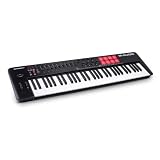
Buying Guide: What to Look for in a MIDI Keyboard for Mac
Key Count and Size
The number of keys determines how much range you have for playing melodies, chords, and bass lines. A 25-key controller is ultra portable and fits on a cluttered desk. A 49-key or 61-key model gives you enough room for two-handed playing and is ideal for songwriting. For a deeper look at portable options, see our best MIDI keyboard for laptop recommendations.
If you are a pianist, an 88-key semi-weighted keyboard like the M-AUDIO Keystation 88 MK3 provides a familiar feel. For beat makers and electronic producers, compact 25-key models are often enough.
Connectivity and Compatibility
Most modern MIDI keyboards connect via USB and work plug and play with Mac. No drivers are needed. Some models add Bluetooth for wireless freedom, which is great for a tidy desk. Check that the keyboard works with your DAW of choice, whether that is Ableton Live, Logic Pro, FL Studio, or GarageBand. For budget-friendly options, read our best cheap MIDI controller guide.
Controls and Pads
Assignable knobs, faders, and pads give you hands-on control over virtual instruments, effects, and mixer levels. Drum pads are essential for beat makers who want to finger drum. An arpeggiator and chord mode can spark new ideas. The Akai Professional MPK Mini series is famous for its responsive MPC pads and deep software integration.
Pitch bend and modulation wheels or touch strips add expression to your performances. Consider what workflow you need most: tactile control for mixing, or expressive keys for playing.
Build Quality and Portability
If you travel or produce in different rooms, a lightweight, compact keyboard with a sturdy build matters. Metal or reinforced plastic chassis last longer. Some models like the DaierTek have built-in rechargeable batteries for true wireless use. For more on category options, visit our MIDI keyboards page.
Final Thoughts
After evaluating all eight models, two stand out for different reasons. For beginners and budget-conscious producers, the Donner Mini MIDI Keyboard N-25 offers exceptional value with its built-in lessons and compact design. For experienced musicians who want professional control and expressive pads, the Akai Professional MPK Mini IV 25-Key USB-C MIDI delivers a complete production toolkit. Whichever you choose, these keyboards will unlock your Mac’s music production potential.
Frequently Asked Questions
Do MIDI keyboards work with Mac out of the box?
Yes, most USB MIDI keyboards are class compliant and work plug and play with Mac. You simply connect the keyboard, open your DAW, and start playing. No extra drivers are needed for 2026 models.
Can I use a MIDI keyboard with GarageBand on Mac?
Absolutely. GarageBand recognizes any standard MIDI keyboard automatically. You can assign controls, record performances, and use the built-in instruments. It is one of the easiest setups for beginners on Mac.
What is the best MIDI keyboard for Logic Pro on Mac?
Any of the keyboards in this guide work well with Logic Pro. The M-AUDIO Keystation 49 MK3 and Akai Professional MPK Mini IV are popular choices because of their reliable performance and seamless integration with Logic’s workflow.
How many keys do I need on a MIDI keyboard for Mac?
It depends on your style. For beat making and synth leads, 25 keys are enough. For piano playing and complex chord progressions, 49 or 61 keys are better. If you are a classically trained pianist, consider an 88-key model like the M-AUDIO Keystation 88 MK3.
